
What defines Low Carbon Aluminum, and how can it support measurable Scope 3 emission reductions?
Key insights of Packaging Europe’s Sustainability Perspectives podcast
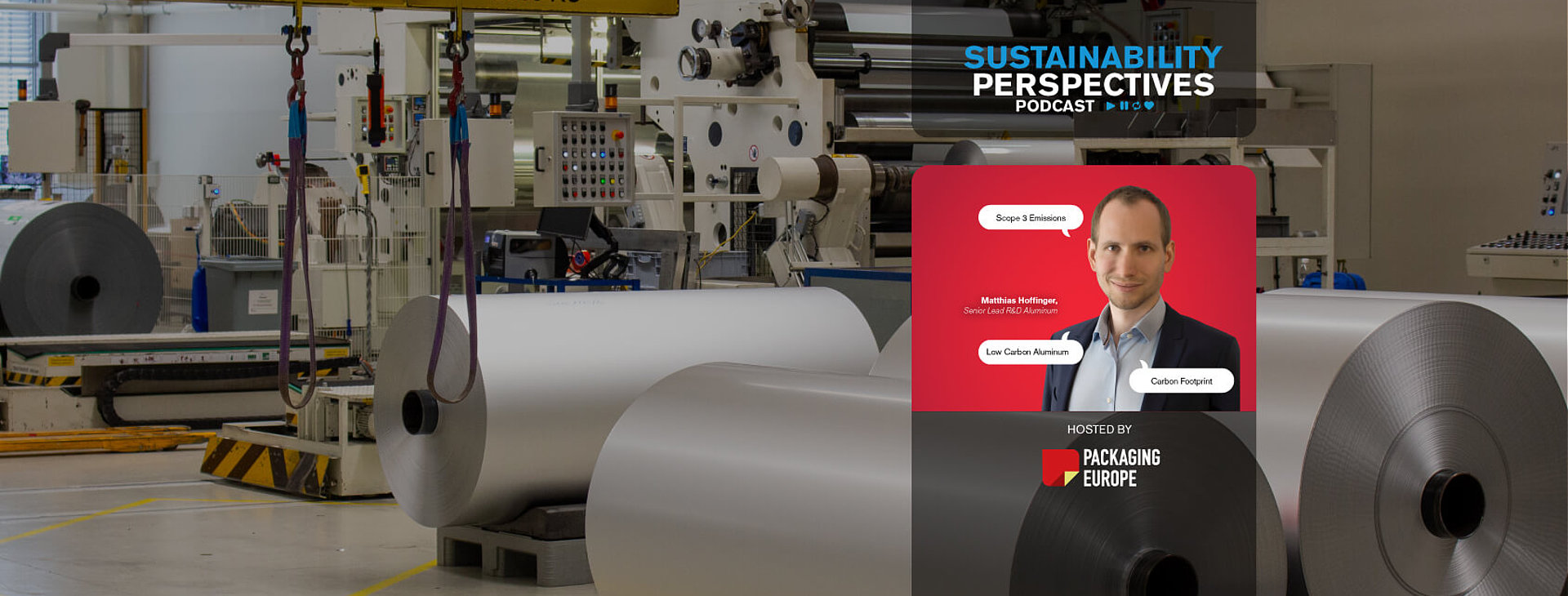
In a new episode of Packaging Europe’s Sustainability Perspectives podcast, our expert Matthias Hofinger, Senior Lead R&D Aluminum at Constantia Flexibles, explains how Low Carbon Aluminum is defined, how its carbon footprint is calculated and verified, and why Mass Balance models are used when materials are physically identical.
The conversation also explores why recycled content alone does not capture the full environmental impact of aluminum, how technical performance is maintained, and which developments are shaping the future of aluminum packaging.
Low Carbon Aluminum is not just about “using renewables” or “being below average.” At Constantia Flexibles, it is defined by a clear footprint‑ threshold at finished foil level (rolled plain foil), verified under ISO 14067 and independently third-party certified, to remove ambiguity and improve transparency.
One of the key advantages of Low Carbon Aluminum is that it enables an immediate reduction in Scope 3 emissions, without complex requalification or homologation processes, making it a practical, near-term‑ lever for customers.
Recycled content alone does not describe the full environmental impact of aluminum. The carbon footprint captures the entire production system, including energy sources, processing efficiency, and residual primary aluminum.
Low Carbon Aluminum shows no integral difference in technical performance compared to standard aluminum. Where higher recycled content is introduced, quality control systems across the value chain ensure consistency and reliability.
Because Low Carbon Aluminum and standard aluminum are physically identical, Constantia Flexibles applies a Mass Balance chain-of-custody model (ISO 22095) (similar to renewable electricity contracts) to track environmental impact without unnecessary material segregation.
Low Carbon Aluminum works like renewable electricity contracts. The material itself is identical, just as we cannot distinguish between an electron produced with renewable energy and one from a conventional power plant. What differs is the environmental impact, which is tracked and verified through a Mass Balance system, not through physical separation.
Get expert support on Low Carbon Aluminum
Low Carbon Aluminum, for us, means a defined carbon footprint threshold at rolled plan foil with verified data quality and third‑party certification